

Faramir Costume Guide: Armor, Clothing, and Accessories
A Faramir costume has to do two jobs at once: establish the Gondor-inspired armor silhouette and keep the softer traveling layers visible around it. The cuirass is the focal point, but the tunic, bracers, belt, cloaks, trousers, and boots determine whether the complete outfit feels coherent and remains practical to wear.
This guide follows the current SokolArmory product page and its live variants. Options can change, so check the listing and selected variant again before ordering.
What the current Faramir costume listing includes
The active Faramir costume listing currently names eight pieces:
- Cuirass
- Tunic
- Bracers
- Belt
- Green cloak
- Trousers
- Boots
- Raincoat
The current variant selector offers full-payment and installment choices for the complete costume, along with separate selections labeled Cuirass, Tunic, Bracers (pair), Belt, Green cloak, Linen pants, Boots, and Wool cloak. That creates two wording differences worth confirming: the written list says “trousers” while the selector specifies “linen pants,” and the written list says “raincoat” while the selector offers “Wool cloak.” Ask which selected option corresponds to the eighth listed piece and what the complete set includes at the time of purchase.
Full-costume payment choices currently appear in S through XL. Individual component variants also appear in those sizes. A separate component selection is not the complete eight-piece costume.

The tunic is the base for the armored torso
The tunic controls the spacing under the cuirass. Its sleeves remain visible at the upper arms and between the elbow and bracers, so both color and thickness affect the finished look. More important, the tunic changes the chest, shoulder, and armhole measurements beneath the armor.
Use the intended tunic during every fitting. A thin T-shirt can make the cuirass seem roomy enough even when the actual garment causes pressure at the shoulders. Raise both arms, rotate the torso, and take a deep breath before adding the belt or outer cloaks.
Check the collar too. It should lie cleanly under the upper edge of the cuirass instead of folding into the neck opening. At the waist, excess fabric should distribute evenly rather than collecting beneath the belt.
The cuirass establishes the Gondor silhouette
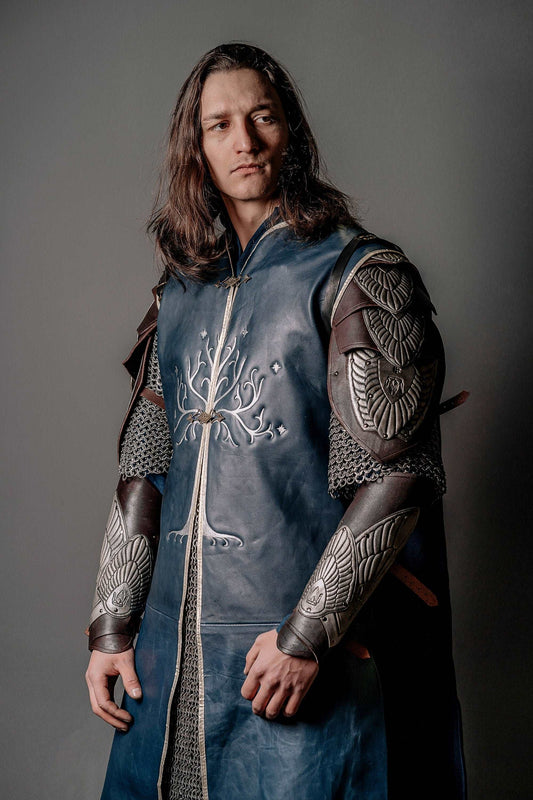
The cuirass is the visual center of this costume. Product photographs show a brown leather torso piece with darker edging and a pale tree motif on the front. The surface has varied color intended to create an aged appearance rather than a flat, uniform finish.
A separate active Faramir body armor with shoulders listing currently identifies one cuirass with pauldrons. That page is useful when you need the armor as a standalone component, but confirm the exact selected product instead of assuming every similarly named cuirass is identical.
Fit the cuirass after the tunic and before the belt. Check three areas:
- The neck opening should not press into the throat when you look down.
- The shoulders should allow a forward reach and overhead arm movement.
- The lower edge should not dig into the waist when sitting.
The back view matters as much as the front motif. Make sure closures remain centered and accessible, and confirm that a cloak can lie over the shoulders without catching on an edge.
Bracers complete the sleeve transition
The listed bracers are offered as a pair in the current variant selector. In the photographs, they extend along the forearms and add another layer of decorated leather between the tunic sleeves and hands.
Measure over the exact sleeves you plan to wear. Then bend the elbow, flex the wrist, and grip any approved prop. The upper edge should not collide with the elbow, while the lower edge should leave enough wrist movement for comfortable handling.
Fasten both bracers and move for several minutes. A bracer that slowly rotates will shift the decorative face away from the forearm and may interfere with gloves or a prop grip. Correct the fit before the final event test.
The belt organizes the waist
The belt separates the armored torso from the lower garments and provides a clear horizontal line. Put it on only after the tunic and cuirass fit correctly. If it is tightened early to compensate for a loose torso, it can distort the lower edge of the armor and create pressure while sitting.
Photographs show additional items carried at the waist, but do not assume every visible pouch, weapon, or accessory is included. The current written list names one belt. Verify the selected variant and included pieces directly on the live page.
During fitting, sit, bend forward, and turn from side to side. The belt should stay level without riding into the ribs or forcing the tunic into a bulky fold.

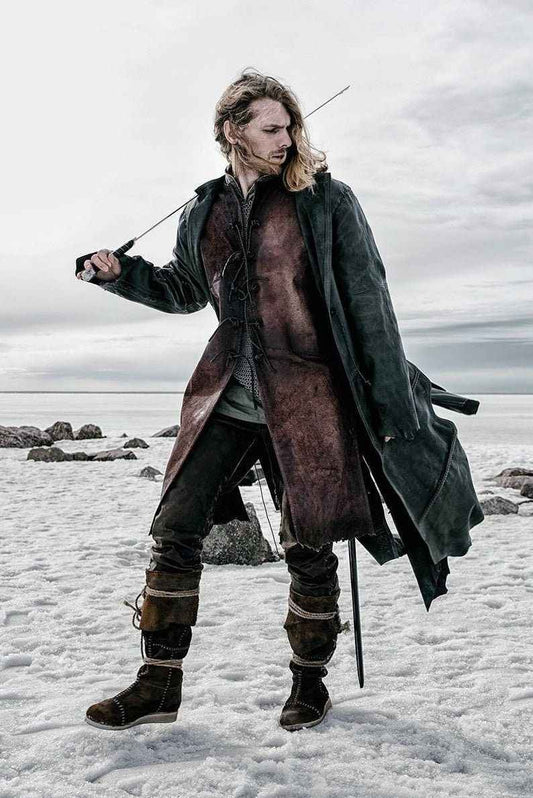
The green cloak and outer wool layer serve different visual roles
The green cloak introduces the strongest color contrast in the set. It softens the hard outline of the cuirass and adds movement behind the shoulders. Arrange it only after the armor and belt are secure so you can see where its weight sits.
The eighth outer piece needs clarification. The included-parts text calls it a raincoat, while the current variant selector calls the separate option a wool cloak. Those labels are not interchangeable. Before ordering, ask for the current material, design, included quantity, and relationship between the green cloak and the eighth outer layer.
Test each cloak separately before wearing them together. Turn your head, raise the arms, sit, and walk up stairs. Check whether a closure pulls at the throat or whether fabric covers access to the belt. If both outer layers are planned for one look, repeat the complete movement test with both in place.
Linen pants and boots finish the lower half
The written list uses the general word “trousers,” while the live component selector currently says “Linen pants.” Confirm that the variant you intend to buy matches the garment shown and described for the full costume.
Fit pants for waist, hip, rise, thigh room, knee bend, and length. The lower leg has to work inside the boot shaft, so do not finalize the hem while wearing low shoes. Sit and kneel to make sure the rise and knees allow movement without pulling the waistband down.
Test boots with the intended socks, insoles, and trousers. Walk, climb stairs, and bend the knees. Check for pressure behind the knee and for fabric twisting inside the shaft. Footwear should be broken in before a long event rather than during it.

Full costume or separate components?
The complete set is the most direct choice when you want all eight listed pieces planned as one outfit. Separate components make sense when you already own a compatible tunic or footwear, need to replace one layer, or want to test the cuirass before committing to the entire build.
Use a written inventory before choosing:
- List every garment and accessory you already own.
- Record its measurements, material, color, and closure points.
- Identify which new pieces must fit above or below it.
- Compare the live variant label with the written included-parts list.
- Confirm whether a selection is one item, a pair, or the complete costume.
The broader costume collection can help you compare complete and modular builds, but similar colors do not guarantee compatible fit, finish, or attachment points.
Measure the complete layer system
SokolArmory's measurement page says customers choose their usual clothing or shoe size when ordering and receive detailed measurement instructions by email after payment. Follow the item-specific instructions and do not add your own allowance unless requested.
Dress in this order for the first full test: base layer, tunic, pants, cuirass, belt, bracers, boots, green cloak, then the additional outer layer if included. Photograph the front, both sides, and back. Walk, sit, crouch, reach overhead, bend the elbows and knees, and access anything carried at the waist.
If you need changes to color, components, or arrangement, the custom-order page explains how to submit references and project details for discussion. Keep the request precise: required pieces, planned use, underlayers, measurements, and any event restrictions.
Final checks before ordering
- Confirm the exact eight pieces included with the complete costume.
- Ask whether “raincoat” and “Wool cloak” refer to the same current item.
- Confirm that “trousers” in the written list means the “Linen pants” option.
- Verify size, material, color, and quantity for every selected component.
- Take measurements over the actual underlayers.
- Fit the tunic and cuirass before setting the belt.
- Choose boots before finalizing trouser length.
- Run a complete movement test with both outer layers.
The Faramir costume works as a system: the tunic spaces the armor, the cuirass defines the torso, the bracers and belt control the transitions, and the cloaks, pants, and boots complete the silhouette. Confirm the live options, then fit the pieces in their real wearing order.


User Name 2 Days ago
Lorem ipsum dolor sit amet, consectetuer adipiscing elit. Aenean commodo ligula eget dolor.